Stillness and Structure: Reflections from Andong, South Korea
There are few places left that feel like pauses in time. Andong, in South Korea’s Gyeongsangbuk-do province, is one of them.
When we arrived, the air felt suspended - the kind of stillness that moves quietly rather than sits in silence. The village sits along a bend in the Nakdong River, encircled by mountains and forests that seem to lean protectively inward. Even before stepping into the streets, there’s a sense of balance - not one imposed by rigid architecture, but one that seems to have existed long before it.
It’s hard to explain the feeling without sounding overly epical, but that’s precisely what Andong encourages - a softening of pace, a deeper noticing. It is a living reminder that architecture is, at its best, a form of listening.

First Impressions
Walking through Hahoe Village, the UNESCO-protected heart of Andong, I was struck by how the entire settlement feels both composed and effortless.
Paths meander, never gridded. Walls curve where they need to, not to assert geometry but to accommodate life. You can tell, instinctively, that the layout is not arbitrary - it follows the contours of land and light.
It’s only later that you learn this is intentional: the village was built according to pungsu, Korea’s form of feng shui, where harmony with the landscape is not a design luxury but an instinctive rule. The result is a village shaped like a lotus flower, opening toward the river, surrounded by the embrace of mountains.
Everywhere you look, the relationship between human and nature feels reciprocal. After all this time, the buildings don’t stand against the landscape, they belong to it.
Architecture That Breathes
What moved me most was how architecture responds. The Giwa집 - tile-roofed aristocratic homes - line the central areas of the village, their dark curved roofs echoing the rolling hills behind them. There’s a rhythm to their eaves, in timber and clay.
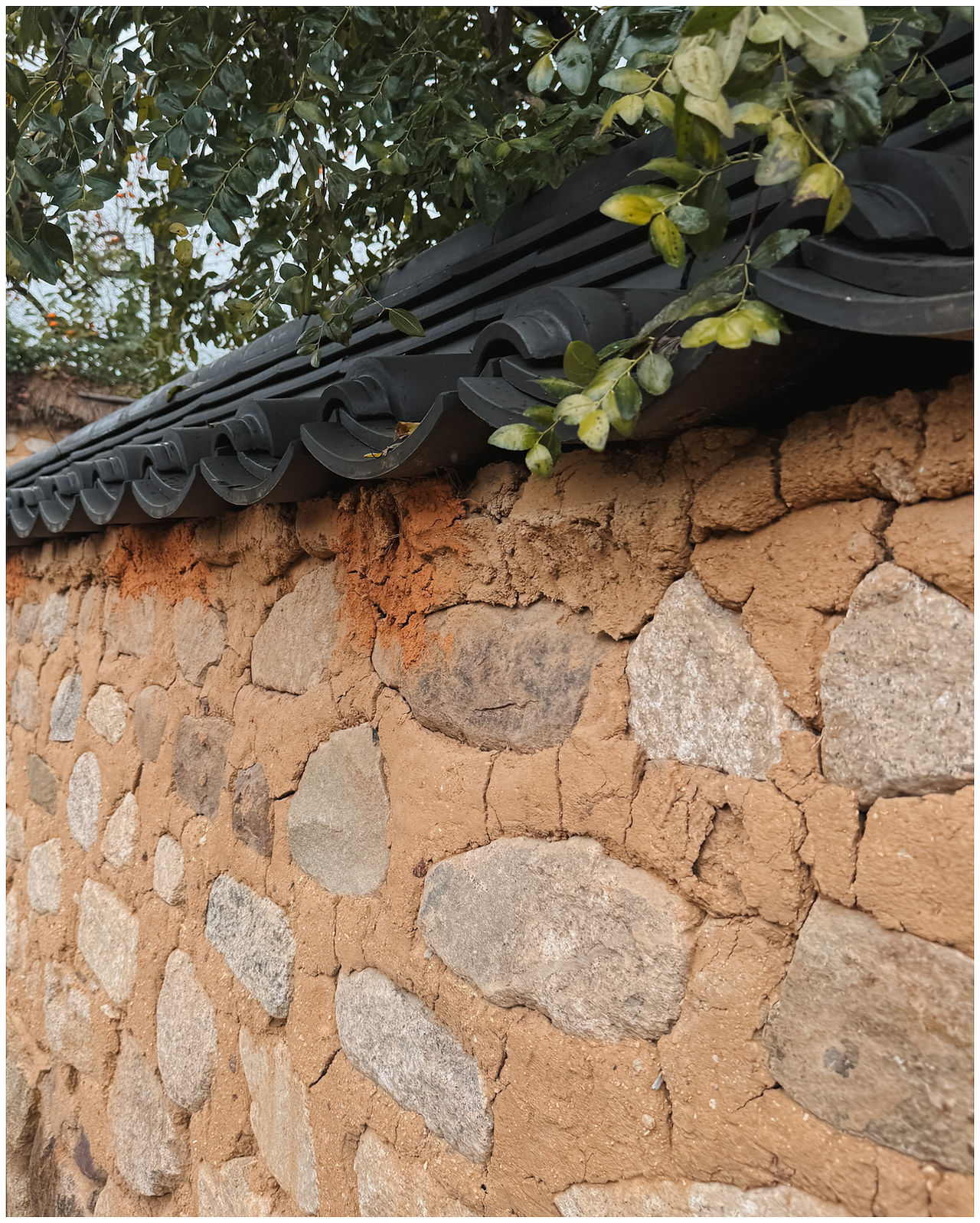
Move closer, and the material honesty becomes apparent. Timber posts, worn by sun and hands. Stone bases weathered by rain. Walls of compacted earth, textured and imperfect. There’s no effort to disguise the passage of time - if anything, the architecture depends on it.
Further along, the Choga집 - the thatched-roof houses of servants and labourers - sit in the same landscape with equal grace. Their thatch is thick, warm, protective. The rooms within are modest, but they open beautifully onto courtyards that spill with pots, tools, and the quiet rhythm of daily life.
In many cultures, hierarchy divides beauty. In Andong, it unites it. The aristocratic and the humble exist side by side, differentiated by scale but not by soul. Both are expressions of human rhythm and adaptation - one refined, one rustic, but both dignified.


Lessons in Balance
There’s a Confucian underpinning to much of this - the idea that everything, from social hierarchy to architecture, should exist in balance. But walking through Andong, it doesn’t feel philosophical so much as instinctive.
The houses are not ostentatious. The tiled roofs of the noble families curve slightly more elegantly, their courtyards are deeper, but they are never showy in today's terms. Even the most prestigious homes open themselves to wind and light. There’s a humility in that.
It made me think about how modern luxury so often means enclosure - more walls, more privacy, more distance from the world. In Andong, wealth was expressed in openness. The mark of status was not isolation, but the ability to host - to bring people into the flow of nature and conversation.
There’s something hugely generous about that definition of comfort.
The Spirit of Study
On the outskirts of the village, lie two extraordinary places: the Wonjijeongsa Pavilion and the Byeongsan Confucian School.
The Pavilion sits raised above a quiet lake, where reeds sway gently and the reflection of the sky shimmers against timber posts. It was once a scholar’s study hall - but it feels less like a building for work, more like a space for contemplation.
The Byeongsan Seowon, or Confucian School, carries that same measured grace. A series of wooden halls and courtyards, it is not grand, but profoundly intentional. The columns form slow rhythms, the courtyards frame pieces of sky, and every movement through the space feels choreographed toward reflection.
I remember standing on here, looking out at the mountains. There was wind, and the faint sound of birds. It struck me that here, learning wasn’t separated from the environment - it was shaped by it. These were buildings that taught not through walls, but through a genuine sense of calm.
A Garden of Coexistence
If the architecture of Andong reflects social structure, its layout expresses coexistence. The noble houses are closest to the river; the thatched homes spread outward, tracing the natural slope of the land. And yet, from any point, the view holds both.
It feels almost like a conversation - wealth and work, intellect and labour, refinement and resilience. Each defined by the other. There’s no sense of exclusion or gatekeeping, only difference held within unity.
It’s a physical manifestation of something that has become rare in modern design: the ability to accommodate social contrast gracefully.

Reflections on Materiality
The textures of Andong have stayed with me long after I left. The tactile grain of wood worn smooth where hands have pushed sliding doors for centuries. The uneven rhythm of stones beneath your feet. The thatch glowing golden in the late sun.
It reminded me of something essential - that materials are not only technical decisions; they are emotional ones.
The wood creaks softly. The air smells faintly of clay. You can almost sense the temperature of the walls. Every surface invites touch, every texture tells a story of maintenance, weather, patience.
In these buildings, nothing is overly designed. There’s a confidence in restraint - as if the builders trusted the landscape to complete the composition. It’s a kind of faith modern architecture (and general lifestyle) rarely allows: faith in time, in imperfection, in the bones being enough.




A Moment of Personal Stillness
In the evening, as the sun was falling, when we walked along the edge of the village. Under the rainy skies, the tiled roofs of the village caught the last light - black, gold, soft grey. Smoke drifted gently from chimneys. Somewhere, a dated but out-of-place radio played.
It was an image of such quiet perfection that I almost didn’t want to photograph it. It felt complete - not in a designed way, but in the way a landscape becomes when everything is in balance.
It made me think about how much of design is about control, and how much of life isn’t. Perhaps beauty, as Andong suggests, comes when those two meet in the middle - when we stop designing to impress, and start designing to belong.
What Andong Taught Me
There are lessons here that travel far beyond Korea.
To design in harmony with place is not a stylistic choice; it is an ethical one. The best spaces - whether a public square or a private home - are those that appear inevitable. They look and feel as though they have grown from the land itself.
To embrace hierarchy without ego is another lesson. Andong shows that different scales can coexist beautifully when guided by shared rhythm and respect.
And perhaps most importantly, to build for sincerity rather than spectacle. The architecture here is not trying to impress you at a first glance. It invites you to stay, to slow down, to observe the details.

Closing Reflection
When I think back on Andong now, I don’t remember extreme details so much as feelings - the way air moved through an ajar paper door, the sound of feet on gravel, the golden light settling over the rooftops.
It is a place that embodies a kind of timelessness - not because it resists change, but because it was designed with such deep understanding of its surroundings that change feels irrelevant.
Andong reminded me that architecture doesn’t need to be loud to be powerful. Sometimes, the most enduring beauty is found in stillness, in proportion, humility, and quiet coexistence.
In the end, that is what good design should do everywhere: not just house us, but hold us gently amongst world.
For more reflections on the impact of thoughtful design, sign up to our weekly KNY Journals Newsletter.

Comments